Proposed Activities
|
||
|
||
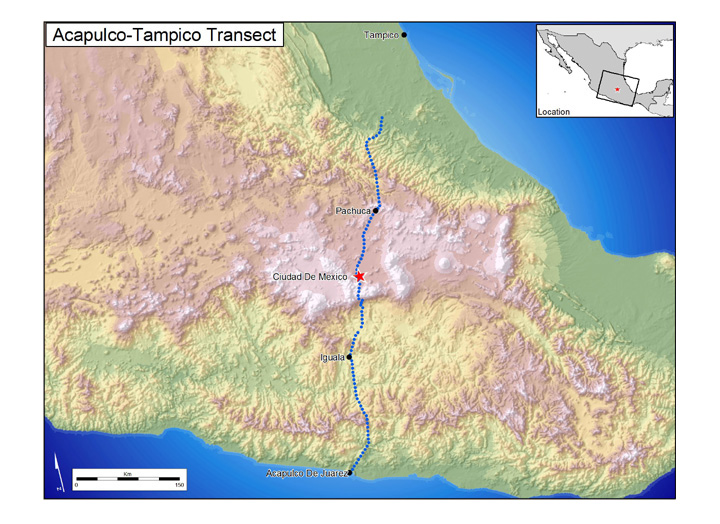
Acapulco-Tampico Transect
|
||
Bibliography
|
||
|
Acapulco to Tampico Line: Preliminary results based on a small array of stations (click here for map) that are either part of the UNAM/SSN seismic array or are stations installed as part of the TO project are shown here, superimposed on Valdez's model.
|
||
|
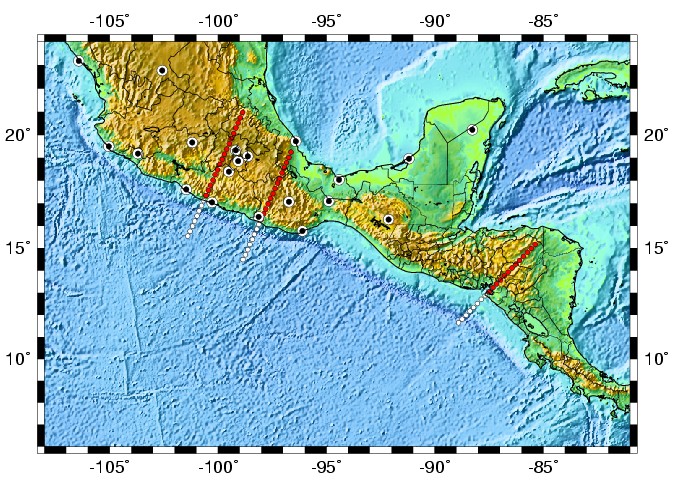
We propose detailed GPS studies looking in particular at the uplift along the seismic lines to estimate the coupling between the upper plate and subducted slab.
|
||
|
The subduction rates, plate age and initial slab thermal state for the model will be provided by the plate tectonic studies. We will also examine the other side of the East Pacific Rise system to look for evidence of unusual features that might have been subducted in the Middle America Trench, but whose conjugate features might still be preserved on the Pacific Plate.
|
||
|
We will construct a database on the geochemistry of Mexican and Central American volcanic rocks by way of four tasks:
We anticipate studying between 50 and 100 samples by one or more of these methods. The collective database will be used to infer the compositions of primitive melts and their degrees of differentiation and hybridization with the crust, and the compositions of those putative primitive melts will be used in turn to infer the temperature and water content of the sub-arc mantle and the phase identity and specific source of slab-derived metasomatic agents added to that mantle.
|
||
|
A suite of dynamic models are anticipated that will allow integration of geophysical and geochemical observations in time and space. Instead of creating just one master model of southern Mexico and Central America, a variety of models will be used to predict specific classes of observations, test specific hypotheses on mechanical and other interior properties, and guide the deployment of instrumentation and sample collection. We will formulate instantaneous models which fully integrate all structural constraints inferred from seismology and geochemistry. Time dependent models (2-D &; 3-D) which will fully incorporate plate tectonic history since the early Miocene will be formulated. Models will be tested against observed topography, gravity, GPS derived surface strain field, surface uplift & subsidence on geological time-scales, structural & stratigraphic constraints on fault growth and slip, and geochemically inferred temperatures and melt transport. During the course of the study, few restrictions will be placed on the classes and geometry of numerical models. For example, the crust can be treated as a cohesive solid, the lithosphere as a visco-elastic solid, and the mantle as a non-linear creep fluid. Percolation of magma through the solid system will be accounted for and faults will either be imposed apriori or allowed to nucleate and grow through time. Local and regional models will not be influenced by artificial boundary conditions as all models will be incorporated into large scale formulations with realistic time-dependent tectonic boundary conditions imposed from global plate/mantle circulation models. We will use all models and data within a framework allowing code coupling and data assimilation in both GIS and plate tectonic reference frames. Initially, models will be used to plan optimal seismic and GPS network configurations. With existing structural and geochemical constraints on slab and mantle wedge melting, we will be able to estimate acceptable models with locally weak mantle wedges (mantle wedges will be weakened through a combination of partial melting and water induced low viscosities). Such weak zones will be mapping into zones of high seismic attenuation. We will then use such attenuation models in the computation of the full seismic wavefield from which we will determine the optimal configuration of broad band seismic networks. As our modeling ability improves and our data base enlarges, we will refine our dynamic picture of how slabs influence the mantle wedge through melting and other transport mechanisms, and in turn how these properties influence surface deformation. With time-dependent models of the downgoing oceanic lithosphere, we would attempt to match the plastic failure of the oceanic lithosphere through the development and growth of normal faults. Such models would be tied to existing bathymetric and gravity observations within the trench, OBS surveys of seismicity within the trench & forebulge, and potentially MCS constraints on the faults at depth within the oceanic crust.
|
||
|
Geological and geomorphological studies of the active deformation in the upper plate near the trench will provide an additional constraint on the details of the plate coupling, and long term deformation. Geologic analysis will also be important for determining the history of the subducted plate.
|
||
|
Long-range magneto-tellurics can provide a measurement of the conductivity in the subsurface. It can be used to directly detect fluids in the mantle wedge.
|
||